

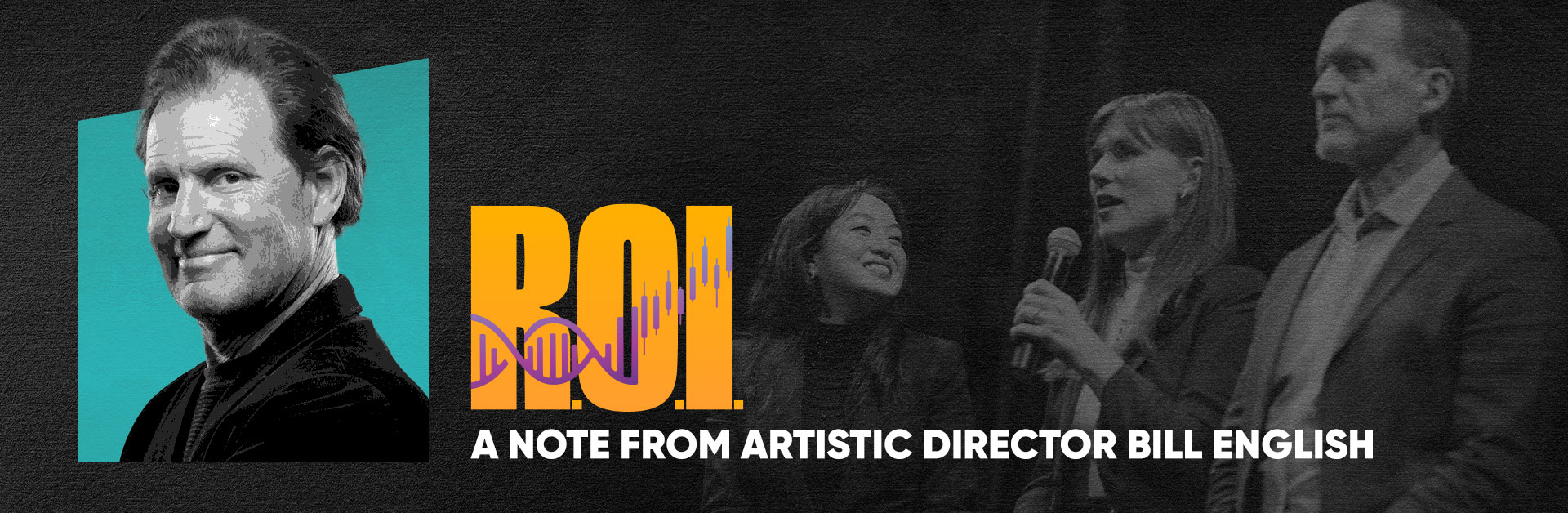
There are moments in history when civilization changes so rapidly that our moral imagination struggles to keep up. We are living through one of those moments now.
Artificial intelligence is transforming our world with warp drive speed. Every day we get news of discoveries that promise longer lives, greater knowledge and unlimited prosperity. Yet along with those promises comes a troubling question. If we create technologies capable of shaping human thought itself, who decides how that power gets used?
No playwright I know has a more finely honed instinct for finding the human drama inside society’s most urgent questions than San Francisco Playhouse’s resident playwright, Aaron Loeb. Aaron doesn’t just write about ideas, he writes about people whose lives are changed by ideas. His characters inevitably find themselves in the vise between ambition and conscience, where every choice brings huge consequences, not just for themselves but for all of us.
In R.O.I., Aaron introduces us to a young venture capitalist who has a knack for recognizing genius. She encounters a scientist whose technology has the potential to change the future, and she risks everything to nurture it. The possibilities are extraordinary: power, wealth, prestige, and the satisfaction of having changed the world. Until the promise of progress starts to raise troubling questions.
What makes R.O.I. so compelling is that Aaron refuses to offer easy heroes or villains. Danger rarely announces itself. More often, it appears wrapped in optimism, the seductive promise of progress. History reminds us that the greatest harms often come not from malicious intent, but from the desire to create something amazing, regardless of the cost.
At the empathy gym we focus our lens on a world increasingly run by mathematical certainty. Our theatre remains one of the few places where strangers come together to wrestle with the unknown. Here, no machine can determine what deserves our attention. No formula can predict our emotional response. We encounter one another directly, sharing the same breath and the same questions.
Perhaps that is why live theatre feels more essential than ever. It reminds us that while artificial intelligence may transform civilization, it cannot replace wisdom, courage or compassion. As Aaron Loeb so beautifully reminds us, the future will ultimately be determined not by the brilliance of our inventions, but by the character of the humans who choose how they are used.
San Francisco Playhouse
450 Post St.
San Francisco, CA 94102
(415) 677-9596
(c) 2024 San Francisco Playhouse
A 501(c)(3) nonprofit organization. Tax ID: 86-1089699
Privacy Policy | Accessibility