

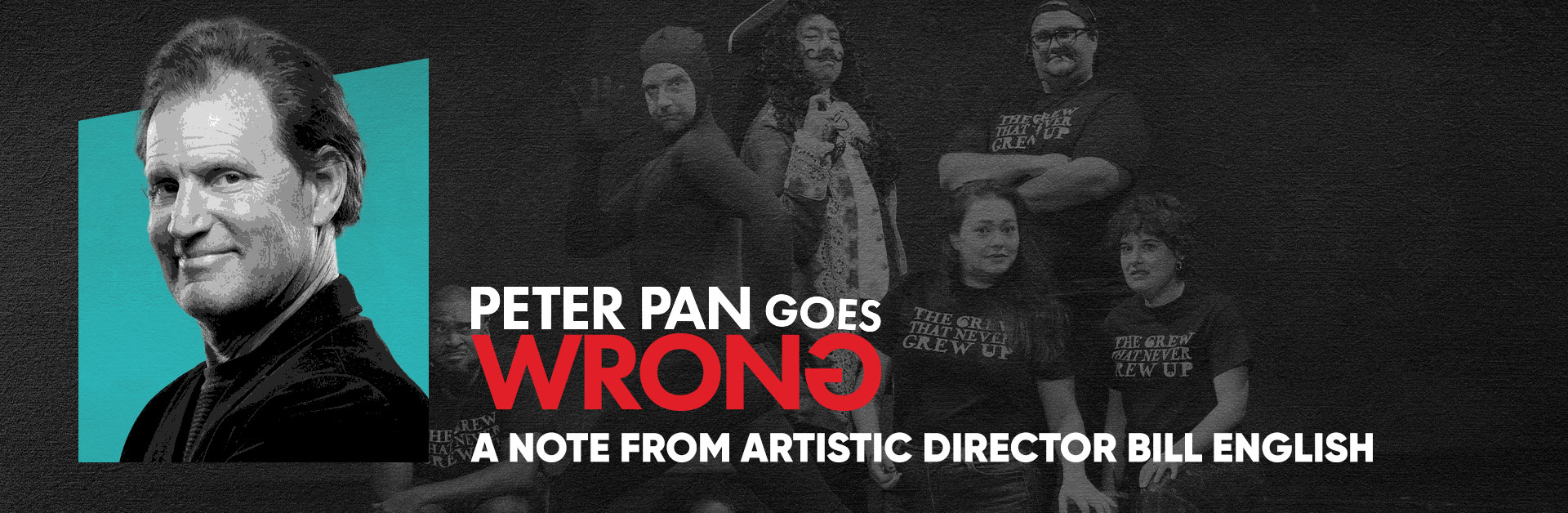
There is something sneakily subversive about taking Peter Pan, one of our culture’s most enduring fantasies about never growing up, and allowing it to go hilariously and spectacularly wrong.
For generations, Peter Pan has embodied the seductive promise of eternal boyhood. It promises freedom without responsibility and adventure without consequence. We even have a “diagnosis” for men who refuse to leave Neverland. “Peter Pan Syndrome.” Beneath the flying, sword fighting and fairy dust lies a deeper question. What does it actually mean to grow up?
For many men (this one included) the choices as we grow up have been presented as two equally impossible poles. At one extreme stands the rigid traditional male ideal. Stoic, controlling, invulnerable. At the other pole, stands the eternal rebel who, refusing responsibility altogether, escapes into perpetual adolescence. Neither will create a satisfying life. Somewhere between Captain Hook and Peter Pan lies the possibility of becoming an adult without surrendering the child within us. Responsibility without rigidity, playfulwithout being reckless. We yearn to be strong enough to be vulnerable.
And then the “goes wrong” franchise adds another glorious layer. Peter Pan Goes Wrong gives us a group of theatre artists earnestly attempting to tell a story while virtually everything conspires against them. The set rebels, the technology revolts, and the machinery has a devilish mind of its own, tormenting the players with endless catastrophe. Yet, they continue.
That is the beauty of farce. We laugh at people tilting at windmills, but beneath the laughter lies something profound. Humans fall down but we get up. We make huge mistakes and while earnestly attempting to fix them, make the mistakes worse. Against all evidence to the contrary, we somehow remain convinced that if we just try one more time, we will succeed.
That is why farce can be uplifting. It transforms failure into perseverance. It reminds us that dignity isn’t found in achieving perfection. Sometimes dignity is simply refusing to give up. At San Francisco Playhouse we practice seeing ourselves in other people. Tonight, we practice something equally essential: laughing at ourselves. Because adulthood may not mean the drive to get everything under control, it may simply mean accepting that we never will while joyously, courageously, and yes, ridiculously, carrying on.
San Francisco Playhouse
450 Post St.
San Francisco, CA 94102
(415) 677-9596
(c) 2024 San Francisco Playhouse
A 501(c)(3) nonprofit organization. Tax ID: 86-1089699
Privacy Policy | Accessibility